Showing posts sorted by relevance for query chinese cities you've never heard of but should know. Sort by date Show all posts

Thursday, March 18, 2010

Chinese cities you've never heard of, but should know - Part 1

China's been working on developing non-coastal cities for years. The pace has been break-neck and the effects are being felt.

From Caixin Online:

Image from foreignpolicy.com

BEIJING (Caixin Online) -- For years, migrant workers in central and western China spent the closing hours of the annual Spring Festival holidays packing luggage and traveling to coastal cities for another year at factory and construction jobs.

This year, the pattern changed. Many migrants apparently chose not to travel east, and several coastal cities started reporting serious labor shortages even before the last fireworks of the Spring Festival died out.

...

It appears migrant workers are continuing to leave their rural villages for jobs in areas. But instead of one of China's traditional manufacturing hubs, such as the Pearl River Delta, many are heading for new destinations.

The head of the National Development and Reform Commission's Small Town Research Center, Li Tie, thinks more migrants will seek jobs in China's interior. That trend would match the government's plans for developing inland cities and moving more production away from coastal areas. Migrants will continue to seek jobs in big cities, official statistics indicate, but fewer will work in coastal population centers.

The government's 4 trillion yuan (about $586 billion) economic stimulus project was expected to steer massive amounts of capital into infrastructure construction in China's interior, creating jobs, Li said.

Not only are jobs moving inland, but compensation levels between coastal and other parts of China have narrowed. A villager who used to migrate to earn 1,000 yuan a month at a distant factory job now has more options closer to home.

Read the Whole Article
There's no doubt that Shanghai, Shenzhen, Beijing and a few other coastal cities are the most developed in China. Those cities are continuing to grow and prosper. They're going to continue to increase their standard of living and level of importance in the world going forward.

Cities outside of the coasts are where things are really going on though.

Just as the cities I just mentioned went through a period of unparalleled growth the past couple decades, cities on the interior of China are beginning to be more and more come into their own. Through the moutains and rivers and and deserts and loess plains, cities like Chongqing and Kunming and Urumqi are booming. Cities that just a few years ago were "the sticks" are now, each in their own way, creating their own identities as economic engines.

Over the coming weeks, I'm going to work on a series of posts: "Chinese cities you've never heard of, but should know." In this series, I'll do my best to introduce cities that people who just know China from Beijing and Shanghai probably aren't that aware of.

I'm not going to used the scientific method to select the cities that fit this criteria. The ones I choose are simply ones that come to mind when I think of "rapidly-developing interior Chinese cities." If any readers have suggestions of places that fall into this category, feel free to suggest cities in the comments section.

I'm going to start this series with a city very familiar to me.

Xi'an (西安), Shaanxi Province (陕西省)


Image from Hubpages.com

Why wouldn't I start with Xi'an. Xi'an is my 中国的老家 (Chinese hometown). I lived in the city for three and a half years. My inlaws live there. Many other people outside of my family I care about deeply still live there. I know the city intimately.

In addition to being a city I've lived in and love, it is right in the heart of China and is a key city for China's development.

Xi'an is the birthplace of Chinese civilization. Thirteen ancient dynasties of China called Xi'an their capital. Xi'an is where the terra cotta warriors were erected and then buried under ground. It was home to the Tang Dynasty, arguably the greatest time period in Chinese history. It was the beginning point on the Silk Road. And a few hours north of Xi'an in Yan'an is where Mao Zedong and the communists stopped after their Long March.

Xi'an's place in Chinese history is unmatched. From the beginning of civilization to today, Xi'an has played a key role in the development of China and of the world.

Now, Xi'an, a city of around 7 - 8 million people, acts as something of a gateway to the West. If you look at a map, Xi'an is directly in the middle of the country.


Although centrally located, it's not culturally or strategically in the middle. In contemporary China, it is considered in the northwest of the country by Chinese people. Xi'an is the last major city in China's northwest. To Xi'an's west and north are deserts and mountains and sparsely populated areas.

Tourism is Xi'an's biggest industry. At least 75% of foreigners who I've talked with that have visited China have been to Xi'an to travel. Although the expat community in Xi'an is nowhere near as large as Beijing or Shanghai's, foreigners in downtown Xi'an are a very common sight. Domestic tourism is also very big in Xi'an. Most Chinese people are aware of Xi'an's Big Wild Goose Pagoda, terra cotta warriors, and nearby Hua Shan. There is major tourism infrastructure being built across many different parts of the city.

The aviation industry, both commercial and military, is a major part of Xi'an economy. There is also a high tech zone, a feature common to many Chinese cities, in the western part of the city. Many international companies have offices in the zone.

That's about all I can come up with at the moment. I'll try to do similar sorts of write-ups here in the near future about other cities in China that are quickly becoming more important.

Saturday, March 20, 2010

Chinese cities you've never heard of, but should know - Part 2

This blog, and a few of the small accolades I've garnered from it, occupied a line on my resume when I was looking for a job in America a few months ago. I had some nice conversations with prospective employers about China and my writing.

The man who ended up hiring me at his company had a lot to say about one post in particular. My Top 10 Travel Destinations in China really struck him.

After hiring me, he told me that he'd been immensely impressed by the information that I'd presented on that Top 10 post. It wasn't my writing style or skills that moved him. Instead, it was simply the fact that I presented new information, geography, and locations that he was completely unaware existed.

The company I'm working at is a reverse logistics company that is closely involved with the trucking industry. My boss and the owner of the company years ago was a trucker. He prides himself upon being a geographical genius. During his trucking days, he'd driven, literally, all over North America. He often engages in discussions about certain cities or terrain he's seen. Maps cover the walls of his office.

Like many Americans, my boss knows very little about China. He knows the most basic of basics about the place. His life has never crossed paths with China and he's never needed to know more than a little bit of information about the country.

My Top 10 list has turned him onto China though. Every few days he tells me about the Google Maps he's looking at and how, as he simply scans random parts of the country, he finds new topography and cities he didn't know about before. He specifically has talked about how crazy it is to "just stumble across a city of five million here and then a city of seven million there."

When listening to him tell these stories one day, one city in particular came to mind - Chongqing. I told him to go look it up on Google Maps and then get back with me.

Chongqing (重庆)


Chongqing is a municipality in southwest China with a population of over 30 million people. The actual urban center of Chongqing is only about five to six million people. But the greater area of Chongqing is much larger and more populous.


I've been to Chongqing. I spent about twelve hours in the city in the summer of 2006. I took an overnight bus from Yangshuo in Guilin Province to downtown Chongqing. I remember not sleeping well and waking up on the bus at about 6AM. As I woke up, I saw building and people bustling outside. I thought we were in downtown Chongqing, or at least very close to the bus' final destination. Instead, we drove through developing outskirts of Chongqing for hours. I finally got off of the bus at about 10AM. I remember looking out the window of the bus hour after hour amazed at the scale of the construction.

Chongqing is the definition of "sprawling."

The purpose for me going to Chongqing was to board a boat headed down the Yangtze River. I took a four day, three night trip from Chongqing to Yichang, the location of the Three Gorges Dam. The trip through the Three Gorges culminating with a stop at the Three Gorges Dam was impressive.

Obviously, the flooding of the Three Gorges and the dam a few hundred miles down river has greatly affected Chongqing. For one, instead of one of the world's great rivers flowing through the city, a, largely, stagnant lake now cuts through the center of downtown. The simple rising of water affected Chongqing greatly. Hundreds of thousands of people who used to reside next to the river, largely in the countryside to the east of the city, had to move. Many of those who lost their homes went to Chongqing.

A couple years ago, American newsman Ted Koppel did a documentary on the Discovery Channel - The People's Republic of Capitalism. For the series, Koppel featured Chongqing as the the symbol of the future of China. Unfortunately, I never saw this documentary and I'm not seeing any videos to put on here from that program. But from the articles I've read about the program, Koppel chose Chongqing because most Americans have not heard of the city.

Although I can't find Koppel's program, I have found a couple other program on Chongqing.

The first is from current.com called "City on Steroids." I just watched this video. It's 28 minutes long. The host is annoying and pretty clueless. But the video is well-produced and the sights and sounds of Chongqing make it worth checking out.


And here's another video I found on Youtube about Chongqing - Chongqing: Invisible City I found on Youtube. It's very much like "City on Steroids" (minus the goofy host). I encourage you to click on the link. For some reason, the video owner has disabled embedding the video.

Chongqing is a city western people should know about. It is one of, if not the, fastest growing cities in the world. It, possibly more than any other city in the interior of mainland China, is going to be an engine for growth going forward.

Disclaimer: I know that these "Cities you've never heard of, but should know" posts aren't groundbreaking. I know that Chongqing and all of the other cities that I'm writing about on these features are nothing new to people knowledgeable about China. Saying that, cities like Xi'an and Chongqing are mysteries to average folks who don't have a particular interest in China. The videos I just posted and the info I just gleaned about Chongqing is, I think, worthwhile. I'm looking forward to trying to get more info on other cities outside the few that people are most familiar with.

Thursday, July 15, 2010

Chinese cities you've never heard of, but should know - Part 4

This installment of "Chinese cities you've never heard of, but should know" isn't actually about a city. It's about Huaxi Village, a village one hundred miles north of Shanghai in Jiangsu Province.


Huaxi Village touts itself as the "Number 1 Village in China." Here is an article from the Guardian on why the village feels so proud:
China's road to riches could not be more boldly signposted than it is in Huaxi, officially the country's wealthiest village. Take the municipal government's stretch limousine across Textile Bridge, pass the smokestacks of the steelworks, speed alongside row after row of symmetrical pale-blue houses, skirt the 15-story pagoda hotel and then alight for a walk down the red-carpeted corridor of capital.

This concrete-covered passageway is a monument to the giddy material progress made by the commune since China's policymakers began mixing their ideological drinks 26 years ago.

None went as far as Huaxi in combining the strict political control of the ruling Communist party with the get-rich-quick economics of the market - and the results are being hailed as a model for the nation to follow.

To demonstrate how good that cocktail is supposed to make the locals feel, "Huaxi Road" is decorated with smiling pictures of every family in the village.

Each household's assets are listed in detail: size of the family, value of their property, average level of education, number of members of the Communist party, as well as how many cars, mobile phones, televisions, washing machines, computers, air-conditioning units, motorbikes, cameras, fridges and stereo systems they own.

At first sight, the figures seem to justify Huaxi's boast to be the "number one village in China". Since 1995, when Huaxi became the first commune in China to list shares on a stock exchange, local businesses, mostly in textiles and steel, have taken off. Their spectacular expansion has made even the national average growth rate of 9% a year seem laggardly. In 2003, the village reported the combined turnover of its companies at 10bn renminbi (about £640m). Last year, it hit 26bn - and by 2008 it is expected to double again.

This has turned residents - all still officially registered as peasants - into wealthy industrialists. Elsewhere in the country, the annual average disposable income of urban dwellers only recently passed $1,000 (about £530). In the countryside, the figure is two thirds lower. But Huaxi's residents get a yearly salary of $1,500, a bonus of $10,000 and dividends of $25,000.

Twenty years ago, most were farmers living in small, one-storey houses, who struggled to save the money to buy a bicycle. Now, they are shareholders with an average living space of more than 450 square metres and at least one family car.

Read On

This article is dated. It is from 2005. Five years is a long time anywhere. But it's a really long time in contemporary China. One important thing has occurred since this story was written; Huaxi Village has embarked upon building two of the tallest skyscrapers in the world.

From The Wall Street Journal:


In China, bigger is almost always better, even in small towns, and Huaxi, a formerly rural village in the eastern part of the country, is no exception.

Huaxi has long been heralded as a symbol of China’s successful transition from communism to capitalism. It calls itself “the No. 1 village in China” and boasts of being the country’s wealthiest village, with an annual per capita income of 80,000 yuan (about $12,000), according to Xinhua. Now, it appears that Huaxi has a new ambition: to become the “tallest village,” not just in China, but in the world.

Officials in the town are currently building a 74-story, 1,100 foot tower to house up to 2,000 residents, at a cost of 2.5 billion yuan ($370 million), the Guangzhou Daily reports (in Chinese here). Planned amenities include five clubhouses and “sky gardens,” 24-hour concierge services, 35 elevators and a revolving restaurant at the top of what’s slated to be the 15th-tallest building in the world. The tower, named “New Village in the Sky,” will be completed in June, but marks only the starting point of the village’s dreams. Next year, construction will commence on an even taller building, the 1,800-foot Huaxi Dragon Plaza (And for this plaza, the total investment will be around 6 billion yuan, and the government is to divide the total 6 billion yuan into 600 shares, with each share 10 million yuan).

Local party secretary Wu Xie’en, told the Guangzhou Daily that he hopes that the skyscrapers of Huaxi will become a major tourist attraction. He also cites a more pressing motive for building upwards: conservation of land resources. Huaxi’s rich residents have long favored sprawling mansions — up to 5,000 square feet in size, huge by Chinese standards– to house several generations under one roof, cutting into the supply of land available for industry and agriculture.

Read the entire article
The excellent blog, Chinasmack.com, translated a Chinese news report from earlier this year on the first skyscraper that is already being built. Here is a clip of that article:
Designed in accord with a 5-star hotel standard, with a construction area of 200,000 square meters, it can accommodate more than 2000 residents, with a dining capacity of 3000, and having the largest 360 degree revolving restaurant in Asia. Inside the building contain 35 elevators, with speeds of 10 meter per second, the fastest in the world, in addition to having the world’s most advanced monitoring and fire safety equipment.”

You must be having a hard time imagining that a “socialist new village” is building this soon-to-be completed luxury tower. In Jiangyin Huaxi village, this building with height ranked number 8 in China, and number 15 in the world will be completed in June of this year.

...

The tower has five sky gardens with five levels in accordance with the Five Elements of Gold, Wood, Water, Fire, and Earth as each level’s theme. Inside contain 35 elevators, with speeds of faster than 10 meters per second, among the top in the world. The form of the tower will be the shape of a “Three-footed tripod”, the center will top out with a 50-meter sphere, as if it is a dazzling pearl.

The tower is also named “The new village in the sky” with a special meaning attached. Wi Xie’en said, “People’s impressions of rural villages were always low-rise buildings, now we must make a breakthrough, even rural villages can break this old impression and create a village in the sky.”

After investigation, this tower originally was planned to cost RMB 1.5 billion, but from the looks of the current situation, after renovations and decorations, it will cost at least RMB 2.5 billion to complete.

Read the entire translation
I have no idea what to say about this hamlet on steroids.

The development going on in Huaxi Village is a good rorschach test for what one thinks of China's break-neck economy. Some will say that such seemingly wasteful and misallocated use of energy and resources will be the undoing of China ("Dubai times 1,000") while others will surely see it as China forging ahead (hooray for Technocracy!).

I don't even want to bother weighing in on these kinds of economic matters any more. I've been bearish in the past on China's development and my natural instinct is to think that this Huaxi experiment is insane. But China's sustained economic development has impressed me. I'm just going to go with "a little from column A and a little from column B" on Huaxi for now.

Regardless of what one thinks of what is going on Huaxi Village, there's no doubt that this little dot on the map deserves to be on a list of places that could only exist in the present-day Middle Kingdom.

Saturday, November 5, 2011

When a Billion Chinese Jump

My biggest problem with living in China when I was there was the pollution. Language issues, trying to understand social mores, being treated differently because I was a foreigner, and any homesickness I felt being on the other side of the planet from my home all paled in comparison to the you-can-only-fathom-it-if-you've-been-there pollution that engulfs China.

Xi'an's pollution, in particular, is horrific. Xi'an, the city I lived in for three and a half years, is just to the south and to the west of the richest coal reserves in China. Xi'an's streets are choked with cars and its economic activity (carbon emissions) is booming. South of Xi'an stand the mighty Qinling Mountains, a very formidable range. You may not know there are mountains near you if you live in Xi'an, though. The peaks of the Qinling range are not visible 350 days out of the year. The beauty of the Qinling Mountains are no match for Xi'an's all-encompassing smog.

Jonathan Watts, a China correspondent from The Guardian, last year published a book entirely about China and its environment, When a Billion Chinese Jump: How China Will Save Mankind - or Destroy It.

I'd heard a lot of hype about this book for more than a year in the China blog and Twitter-sphere. Having now read it, the book lives up to the big buildup it's garnered. When a Billion Chinese Jump expanded and refined my knowledge of environmental issues in China a great deal. Watts' book put important facts and figures into my brain to go along with the negative experiences I've had with China's pollution.


The organization of Watts book is very good. It is split into four sections - Nature, Man, Imbalance, and Alternatives - and highlights each of these themes by focusing on different corresponding regions in China - the Southwest, the Southeast, the Northwest, and the Northeast. The result is a full portrait of what is going on in the humongous land mass that is China. The good, the bad, and the ugly all make it into Watts study of Chinese people and their relationship with their land.

I've talked before on my blog about how western China is the most interesting part of the country to me. The West is the frontier land of China that is often overlooked by journalists and policy-makers who only spend time in the large metropoli of eastern China.

Nobody can accuse Watts of not getting the full picture of China in When a Billion Chinese Jump. He visits nearly every nook and cranny of every corner of China - the snow-peaked mountains and glaciers of Tibet and Sichuan, the barren deserts of the former Silk Road in Xinjiang, and the idyllic scenery of Yunnan - to get the widest-ranging scope of China's environmental impact possible.

One thing I found very interesting on a personal level is that Watts visits every city in the on-and-off series on this blog - Chinese Cities that You've Never Heard of But Should Know. The giant factory that is Guangzhou and its surrounding area, the "model village" of Huaxi, the excesses of Ordos, and the Bladerunner-esque city of Chongqing are all places that Watts highlights.

I think it's pretty cool that Watts and I see eye-to-eye on what are the larger-than-life stories going on in China today. There were several points in When a Billion Chinese Jump where I felt Watts had written the book just for my reading. That's a great feeling to get when plowing through a meaty book.

One of my favorite chapters in the book is titled, "Why Do So Many People Hate Henan?" I laughed out loud when I saw chapter title in the table of contents. I imagine that anyone who's ever lived or spent a some time in China know the reputation that Henan Province and its people have amongst non-Henanese Chinese people.

Watts writes: "The antipathy of so many Chinese feel toward Henan seems to mirror the prejudice that many foreigners express towards China: that it is dirty, overcrowded, and untrustworthy."

Watts reminds the reader, though, that Henan is the birthplace of some of the most glorious Chinese things from China: tai qi, kung fu, and Zen Buddhism. Watts writes convincingly that Henan, which at one time was a bucolic place, is the dystopia it is now because of a systematic destruction of its environment. Instead of being known for some of the most beautiful things China has offered to the world, Henan is now famous for pollution-induced cancer villages, corruption-induced AIDS villages, and the worst of the worst man-made problems in China.

The story of Henan is tragic. Watts hammers what's gone on there hard because the entire country of China is on the brink of becoming one big Henan-like hellhole.

I'm going to highlight a passage from When a Billion Chinese Jump that I liked. It features a general theme found throughout the book: ingrained Chinese cultural traits make one wonder whether there is any hope that China will be able to change its attitude towards its environment.

From page 68 and 69:


Whether China's deeply ingrained negative cultural attitudes towards nature can be overcome is going to be one of the most important things to watch in the world over the next several decades.

My only criticism of When a Billion Chinese Jump is that it, at times, sounds a bit patronizing. Hearing Watts, an Englishman, lament fast food's growth, the Barbie store in Shanghai, and China's embrace of materialism was a bit much at times. I do think that it is near impossible to avoid this problem when a westerner writes a critical book about a developing country. Reading about "Barbie's eco-footprint" (the CO2 that Barbie, if a real person, would've been responsible for emitting) made me cringe some, though.

Watts book is a great guide to understanding China's struggle to build sustainable economic and societal structures. Watts knows a ton about China and such is reflected in his very serious, yet readable, book. I recommend anyone with even a hint of a green world-view or interest in China to pick up When a Billion Chinese Jump.

Wednesday, January 26, 2011

Chinese cities you've never heard of, but should know - Part 5

The city featured in this installment isn't a city yet. It is a cluster of cities in southern China that will one day in the not-too-distant future be, at 42 million people, the largest city in the world.

From The Telegraph:


City planners in south China have laid out an ambitious plan to merge together the nine cities that lie around the Pearl River Delta.


The "Turn The Pearl River Delta Into One" scheme will create a 16,000 sq mile urban area that is 26 times larger geographically than Greater London, or twice the size of Wales.

The new mega-city will cover a large part of China's manufacturing heartland, stretching from Guangzhou to Shenzhen and including Foshan, Dongguan, Zhongshan, Zhuhai, Jiangmen, Huizhou and Zhaoqing. Together, they account for nearly a tenth of the Chinese economy.

Over the next six years, around 150 major infrastructure projects will mesh the transport, energy, water and telecommunications networks of the nine cities together, at a cost of some 2 trillion yuan (£190 billion). An express rail line will also connect the hub with nearby Hong Kong.

"The idea is that when the cities are integrated, the residents can travel around freely and use the health care and other facilities in the different areas," said Ma Xiangming, the chief planner at the Guangdong Rural and Urban Planning Institute and a senior consultant on the project.

Read On
There's no doubt that there will be plenty of people willing to populate this new monstrosity. Tens of millions of people flock to Chinese cities every year. Everybody in China wants to get in on the new opportunities city life provides.

The audacity of this plan is startling. This project in southern China makes previous large infrastructure projects - the Panama Canal, the US interstate highway system, and even the Three Gorges Dam - seem like child's play. The logistics involved with creating such a vast "city" is on a totally different plane from previous man-made ventures.


Image of Shenzhen from Reuters

Reading this story today, I immediately thought of some of the words President Obama said last night in his State of the Union address. From near the end of his speech talking about the need for the US to become a more competitive nation:

We should have no illusions about the work ahead of us. Reforming our schools, changing the way we use energy, reducing our deficit — none of this will be easy. All of it will take time. And it will be harder because we will argue about everything. The costs. The details. The letter of every law.

Of course, some countries don't have this problem. If the central government wants a railroad, they build a railroad, no matter how many homes get bulldozed. If they don't want a bad story in the newspaper, it doesn't get written.

And yet, as contentious and frustrating and messy as our democracy can sometimes be, I know there isn't a person here who would trade places with any other nation on Earth.

The Entire Transcript
There's no question who these words were targeted towards. China is a challenge Obama has to deal with every day.

Obama spent last week schmoozing President Hu here in the US. He surely hears everyday from disgruntled voters out of work due to "jobs being shipped over to China." Forty-seven percent of Americans believe, incorrectly, that China's economy is the largest in the world.

I was moved by Obama's speech last night. I've seen many mock his "Sputnick-moment" rhetoric. I'm also not sure that the post-partisanship he's pushing for is going to last. But I appreciate the, to borrow a word I've already used in this post, audacity of what he said last night.

No matter what one thinks of Obama and his policies, he proved last night that he understands what has made the US what it is. His exhorting of innovation and ingenuity in the face of strong challenges from abroad was inspiring.

Is China's economy and world influence going to surpass the US in the coming decades? Most likely it will. Considering its population, it's not that surprising that it would. But even if it does, I think there's something to what Obama said in his speech.

China's economy can and will continue to boom. It will build cities and undertake projects that put America to shame. No matter how big it gets, though, China's citizenry is still not going to have basic rights that citizens of the US and other democracies enjoy. No amount of development or wealth creation will ever be able to make up for the basic freedoms denied in China.

Saturday, April 24, 2010

Chinese cities you've never heard of, but should know - Part 3

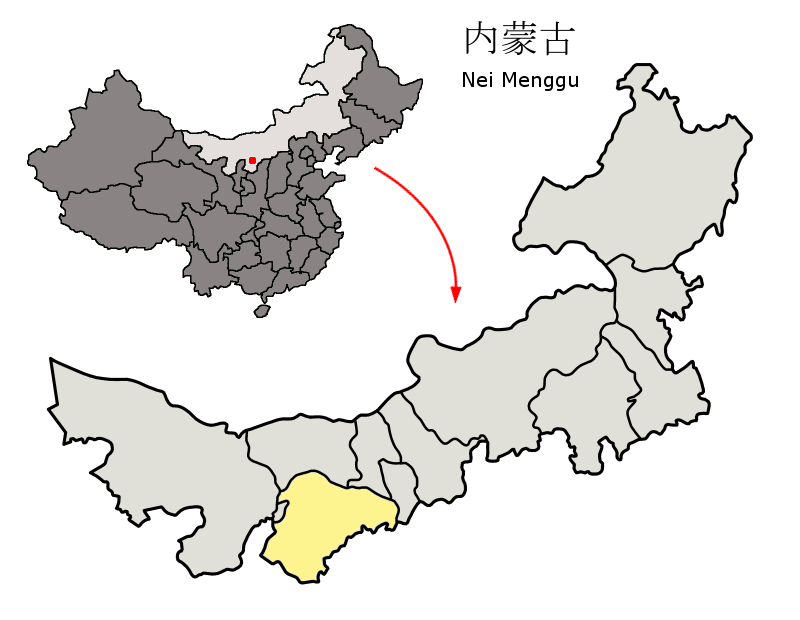
Ordos, a city in Inner Mongolia, is arguably growing faster than any other city in the People's Republic of China. In the middle of the Ordos Desert, the city already boasts the second highest per capita income in China (after Shanghai).


Image from Wikipedia

Ordos' wealth largely comes from its natural resources. The Ordos region has 1/6th of all the coal reserves in China. It also is where most of the cashmere in China comes from. Here is an article from the Ordos government's website on the city's natural bounty:
Ordos is abundant with resources, among which the most well-known are Sheep, Coal, Kaolin and Natural Gas. Aerbasi cashmere, known as “fiber diamond” and “soft gold”, is noted for its long and thin fiber. The annual output of Aerbasi cashmere in Ordos is more than 700,000 kgs, and the annual production capacity of cashmere sweaters exceeds 8,900,000 pieces, which are exported to places all over the world.

Ordos has 149.6 billion tons of proven coal reserves, accounting for about one-sixth of the total amount nationwide and half of the entire quantity in Inner Mongolia. Ordos coal enjoys the advantages of low ash, low sulfur, low phosphorus and high heat output, thus was recognized as “clean coal” by Chinese and foreign experts. Till now the coal mines developed include mainly Zhungeer, Dongsheng, Wanlichuan and Xizhuozishan. In 2007 a total 198.5 million tons of coal was produced.


Read the Whole Article
While rich in natural resources, the Chinese government is also investing a lot of human capital into the the region as well.

Ordos is set to build the largest solar power plant in the world. Here is a small blurb about the proposed solar plant from last September in gizmag:
In the midst of overwhelming debate over climate change - an issue that seemingly paralyzes politicians - the Chinese government has announced its intention to construct a 2-gigawatt solar power plant in Ordos City, Inner Mongolia. Mike Ahearn, CEO of the Arizona-based company which will construct the plant, describes the unprecedented project as “an encouraging first step forward toward the mass-scale deployment of solar power worldwide to help mitigate climate change concerns.”

...

The magnitude of the development is many times greater than any solar plant in operation or even contemplated, including projects such as the 290-megawatt Starwood Solar I and the 500-megawatt solar thermal project in the Mojave Desert.

If successful, the Ordos plant will cover a staggering 25-square miles, cost billions of dollars and power 3 million Chinese homes.


Read the Whole Article
In addition to the solar plant, the Chinese government has invested massively in a new section of Ordos called Kangbashi. Local officials are hoping that their development of Kangbashi's infrastructure will one day allow its residents to have the same luxurious lifestyle that the wealthy in Shanghai, Beijing, and other more developed cities currently enjoy.

The build up of Kangbashi is controversial. It's questionable because, well, nobody lives in this district that is being fiercely developed:

First, an article on the building of Kangbashi from Foreign Policy:


In the gritty Inner Mongolian wind, I stood at the pinnacle of the global economy, at least in terms of GDP growth: the main drag of one of the fastest growing cities in the fastest-growing region in all of China, the world's supposed new economic powerhouse.

Built in a breakneck five years, Kangbashi is a state-of-the-art city full of architectural marvels and sculpture gardens. There's just one thing missing: people. The city, built by the government and funded with coal money, its chief industries energy and carmaking, has been mostly vacant for as long as it has been complete, except for the massive municipal headquarters. It's a grand canyon of empty monoliths. In a paradox only possible in today's economic system, Kangbashi manages to be both a boom town and a ghost town at the same time.

Kangbashi represents a particularly destructive economic force at work in China today: an obsession with GDP that ignores all other metrics of progress or human capital. GDP as calculated in China -- or the rest of the world, for that matter -- doesn't make any distinction between quantity and quality, or between creative and destructive expenditures.

...

Still, China's emphasis on growth at all costs is creating some bizarre monsters, and Kangbashi is one of them. Six years ago, Ordos county officials decided to move their headquarters out of old, cramped Dongsheng and into land that was then occupied by two small villages inhabited by about 1,400 people. By the end of 2008, the new district of Kangbashi was crisscrossed with 2.4 billion yuan ($352 million) worth of roads. Officials initially said they expected the population to reach 100,000 this year and 300,000 by 2020. They also say the population reached 50,000 last year, which seems improbable given that pedestrians on the street were outnumbered by street sweepers. A local real estate agent, Cao Ting, told me it had actually been easy to sell apartments. She said 80 percent of the apartments had been sold. I believed her even though 80 percent of them looked empty, with no curtains or furniture visible during the day and no lights on at night. The buyers were mostly investors or future residents waiting for schools and hospitals to open before moving in.

Read the Whole Article
Second, a video from Al Jazeera on the ghost town:


And third, a photo-essay on Kangbashi from Time Magazine (click the link for all fourteen of the images):


On the second page of the Foreign Policy article from above about Kangbashi, it says the following:
The new buildings look great from the outside, and they're economically fine on paper, if you believe the local government. And they may continue in this state, since the government will prop up the property market because it holds up so much else as well. Local governments' revenues are completely dependent on land sales. Eventually, perhaps, the population will catch up with this accelerated development.
I'm not sure what that long-term implications of the break-neck development Kangbashi and Ordos are. I find such wild development troubling. The construction is being propagated by a system - both government and private - that is almost utterly dependent upon making money through eating up and developing real estate. Such an economic system is predicated on higher and higher real estate prices going forward. Being an American who's witnessed the folly of such practices, I'm weary of this kind of stuff.

Saying that, I wouldn't bet against those apartments filling up with people in the coming years. Of course, China's economy needs to continue to boom and its people need to get richer and richer for that to happen. But at this point, it looks like China's economy is immune to the economic bug that the rest of the world has come down with.

China's economy, largely directed from central planning as opposed to private enterprise, continues to develop. And Ordos is at the front of the pack of the large number of cities pushing forward.

Sunday, December 6, 2009

My Top 10 Travel Destinations in China

I've traveled much more extensively in China than I have America. The people I've met, the things I've eaten, and the scenery I've witnessed in China are things that I'll never forget. China is a HUGE country that has MANY different opportunities for a traveler.

Seeing how many places I've been in China, it'd be prudent for me to publish a "Top 10 Travel Destinations in China" list. This is a subjective list of places that I enjoyed the most. So there is surely room for disagreement or discussion.


I'm going to make one qualifications before I present the list.

No metropolises are on my list. Places like Beijing, Shanghai, and, of course, Xi'an are all great cities. But this list is more focused on specific destinations and sites. I also prefer traveling to natural scenery as opposed to spending my vacation time walking down the skyscraper-laden streets of crowded cities. So while there are many worthwhile major cities in China worth visiting, I'm not including such places on my list.

To the list:

Mark's Top 10 Travel Destinations in China

10. Dali, Lijiang, and Tiger Leaping Gorge (Yunnan Province)


Scene at a lake in Lijiang

I was the sickest I've ever been in my life while visiting these three destinations. While in Lijiang, I made a major mistake; I ate a salad. The ensuing two weeks were hell. I eventually figured out I had giardiasis and fought the sickness with antibiotics.

The experience of being sick in Yunnan certainly tainted my experience there. I couldn't bike ride in Dali. I didn't hike the high trail of Tiger Leaping Gorge. I was able to walk around a lot in Lijiang, but I couldn't enjoy a lot of the fun things about the village.

Dali is a small village teeming with coffee shops, women in ethnic minority garb, and western hippies. It has an immensely laid back vibe.

Lijiang the perfect place to take a Chinese woman on a honeymoon.

Tiger Leaping Gorge is the deepest gorge in the world. From what I hear, the views from the high trail are more than worth the hike.

Although I was deathly ill in Yunnan, I could tell that it would've been a joy if I'd been healthy.


9. Pingyao
(Shanxi Province)


An alleyway in Pingyao

I wrote a detailed article about my experience in Pingyao here. It's something of an enigma: an oasis of Chinese history and modern travel comfort all the while being dead in the middle of China's coal country. Just walking down the streets here is an experience. Be sure to eat the local specialty - 土豆烧牛肉 (beef and potatoes).

8. The German Concession and the Beaches of Qingdao (Shandong Province)


The German section of Qingdao

I spent ten days in Qingdao by myself in the summer of 2006. I'm pretty sure it was in Qingdao that I realized I don't really like traveling by myself. Saying that, Qingdao is worth a visit.

Qingdao has a lot more character than most big cities in China. To me, it seemed as though there was the German concession area built a hundred years ago, the new skyscraper section of the city, and practically nothing in between the two.

Walking through the winding hills of the German section and the summer beaches with hundreds of swimmers are things you'll remember.


A beach with modern Qingdao in the background

7. Heaven Lake and Turpan (Xinjiang Autonomous Region)

Heaven Lake and Turpan aren't that close to each other. I'm lumping them together because they are both a couple hours (in opposite directions) from Urumqi, the capital of Xinjiang Autonomous Region.


Heaven Lake

Heaven Lake is what I have always pictured western Canada to look like. Heaven Lake is at an elevation of 6,500 feet and the mountains surrounding the lake tower over 20,000 feet. My brother and I camped out at the lake for one night in the summer of 2007. Although we were there in the summer during peak season, once we started walking along the paved trails, we had the place to ourselves. We hardly saw anyone. Setting up camp, eating, and lugging around heavy backpacks was a very serene day.


Me and my brother riding camels outside of Turpan

A couple days after going to Heaven Lake and taking a day to rest in Urumqi, my brother and I headed to Turpan. Turpan is an old desert oasis town along the Silk Road. It is littered with old sites and relics thousands of years old. It is HOT in Turpan. But eating in the night markets, seeing the old sites, and getting intimate with the small Muslim town is well worth being hot for a couple days.

6. The Great Wall from Jinshanling to Simatai (Beijing)


We were lucky enough to see a rainbow while at the wall

Jinshanling and Simatai are THE places to see the Great Wall. I've been to the Mutianyu section of the wall. It wasn't bad. But it paled in comparison to Simatai.

Jinshanling to Simatai is difficult. The beginning of the hike is about three hours by bus from Beijing (much further than any of the other sections) and it is steep. One must be prepared for a very grueling hike. In fact, I'd say only healthy people should attempt this section the wall. But the payoff for the hard work is sublime. Be sure to spend 35 kuai and ride the zip line at the end section.

5. Emei Shan (Sichuan Province)


Me, with a monkey on my back

My brother and I refer to Emei Shan as "Monkey Mountain." Talk about a mystical place.

At Emei Shan, one can run across wild monkeys, see some of the most pristine forests in China, see Daoist hermits making pilgrimage, stay in practicing Daoist monasteries, hike some of the most grueling paved trails I've ever seen, and see summits thousands and thousands of feet above ground (and the clouds).

Because we were only at Emei Shan for two days and one night, my brother and I didn't even make it to the (what I hear is) beautiful summit of Emei Shan. Even though we didn't see the entire mountain, climbing half the mountain is, by far, one of the most memorable things I've ever done.

4. Xiahe and the Labrang Monastery (Gansu Province)


My friend, Andy, two French tourists, and I were the first foreigners to visit Xiahe and the Labrang Monastery in months and months last October. The city had been closed since the riots that took place in the run up to the Olympics. Locals in the city told me they hadn't seen foreigners in months before us.

The story of how we got to the city is, indeed, unbelievable.

It involves being denied tickets on a public bus. Finally convincing the ticket sellers to let us get on the bus. Being stopped at a military check point at the outskirts of the city. Having armed guards (with massive guns) run on to the bus and bark Chinese at us (and particularly me since I was the only one of us who could speak Chinese). Being told by a slick, English-speaking government official that we were NOT supposed to be in Xiahe. And ultimately negotiating an agreement where we could see the Labrang monastery as long as we stayed where the government wanted us to, didn't leave our hotel once we got there, went straight to the monastery at 8AM the following morning, left the monastery at noon, and then left Xiahe before sundown the following day.

Yeah, it was intense. I saw a locked down and repressed community first hand.

Despite the drama of geting to Xiahe, we did end up getting to the Labrang Monastery, the most holy Tibetan monastery outside of the Tibetan Autonomous region. Thankfully, once we finally got lost in the maze of Xiahe's narrow streets, the Tibetan monks, Tibetan pilgrims, and Chinese tourists roaming the streets couldn't have been friendlier.

The highlight was being invited in by a monk into his personal residence. As Andy and the two French tourists we were with walked into the small hut, we heard monks chanting and could smell incense burning. Since I was the only person who spoke Chinese, I acted as translator for the four of us and him. We had tea and relaxed with him for about a half hour.

Getting to spend time with a monk given the situation in Xiahe and the monastery was a once-in-a-lifetime experience. It's something I will never forget.

3. Yangshuo and Longji Rice Terraces (Guangxi Province)


Just outside of Yangshuo

I can't believe that there is a more beautiful place on Earth than Yangshuo. Its terrain is unworldly.

Yangshuo is all about the scenery. Get out and enjoy it any way you can. Go on bamboo rides on the Yulong River. Rent a bike. Rock climb (it's supposedly the best place in China to climb).


The Longji Rice Terraces

While taking a break from adventures in and around Yangshuo, take a day trip to the Longji rice terraces. Built over hundreds of years, they are just magnificent trophies of human achievement.

2. Kashgar and Karakul Lake (Xinjiang Autonomous Region)


A scene from the Sunday market

If you've been putting off a trip to Kashgar, go now. The old city is presently being razed. Once it is gone, a true relic of Uighur culture will be forever lost.

One of the big highlights of Kashgar is its weekly market. I was blown away by the event. Thousands upon thousands of Xinjiangese from Kashgar and the areas surrounding Kashgar descended up the outskirts of town to trade goods in one market and livestock in another. These markets and the old city of Kashgar do not feel like China at all.

Incredibly, a natural scene unlike any other I've ever seen is just a few hours by car from Kashgar: Karakul Lake.


Me at Karakul Lake

Karakul Lake is at 13,000 feet and is surrounded by 25,000 foot mountains in all directions. That pretty much says it all. Pictures don't do this place justice. Camping here with my brother in 2007 was just... I've run out of superlatives.

The exotic feel of Kashgar with Karakul Lake not too far away make for a truly one-of-a-kind travel destination.

1. Hua Shan (Shaanxi Province)


Above the clouds at Hua Shan

After just writing about Kashgar and Karakul Lake, I feel like objectively they are "cooler" places than Hua Shan, a mountain a couple of hours east of Xi'an. But Hua Shan has some kind of special pull for me. I've climbed atop Hua Shan three times. Each one more intense than the last.

I don't know what it is about climbing the thousands upon thousands of steps that take one to the top of Hua Shan, one of the five Daoist holy mountains in China. All I do know is that I've never been to a place more magical than the place.

Compiling this list was fun. I really enjoyed thinking about all of the great places I've traveled in China. I can't wait until I can get back out to China to do some more!