Wednesday, July 29, 2009

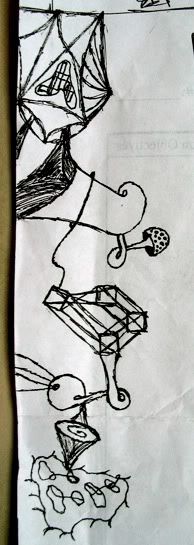
Photos of the Week - Doodles

Bear with me here.

These doodles don't have anything to do with China. They're just random drawings I've done over the past year or so.

I've always enjoyed drawing. When I was in high school, I turned a corner a bit in the development and complexity of what I was doing. My drawing became markedly more abstract.

Towards the end of high school I drew several really intricate pieces. In more recent years, I've hardly done anything at all.

These drawings, mostly done during down time of observations that I do at my school (notice the random comments I have on their classes on the sides), are the first drawings I've done in years. I like a couple of them a lot.


This is the most "advanced" one I've done in a long time. It took me several hours of the course of a day.


Monday, July 27, 2009

US/China Summit

China and America kicked off an important round of meetings yesterday.


Photo found on Trailerparknews.com

For many years, U.S. officials traveled to Beijing and lectured the Chinese about the value of their currency and the need for economic and political reforms.

On Monday, about 200 senior Chinese officials traveled to Washington and heard soothing words of reassurance from U.S. officials: The dollar is still sound, your investments are safe and we are working really hard to restructure our economy.

Such is the nature of the U.S.-China relationship today. Behind all the reassuring language is a nervous sense that the fate of the world economy is increasingly dependent on the United States and China working together.

President Obama opened the first meeting of the U.S.-China Strategic and Economic Dialogue on Monday by declaring that the two countries share a responsibility for the 21st century, and should strive to cooperate not only on economic matters but also on key issues such as climate change, nuclear proliferation and transnational threats.

"The pursuit of power among nations must no longer be seen as a zero-sum game," he said at the start of the two-day meeting, held at the Ronald Reagan Building and co-chaired by Secretary of State Hillary Rodham Clinton and Treasury Secretary Timothy F. Geithner. "Progress -- including security -- must be shared."

The meetings are intended mostly to allow officials to exchange views on a wide range of issues and to establish contacts in each other's governments. On Monday, Obama gave a gentle prod to China on its human rights record, noting that "all people should be free to speak their minds," but otherwise focused on forming with China a partnership "of opportunity."

...

"The United States will never become China, and China will never become the United States," he (State Councilor Dai Bingguo, who oversees foreign policy) added. "But the living fact is that China and the United States' interactions have never been so frequent, our interest has never been interwoven so closely, and the mutually beneficial cooperation between our two countries has never been so broad, and the driving force boosting the China-U.S. relationship has never been so strong."


Read On
I hope that these talks can be fruitful and do some good.

There's little doubt that the election of Obama has done a good job of garnering favor from the citizens of the world. America's favorability ratings in China went from 34% in 2007 to 47% now in 2009. Hopefully some of that good will has also spread to the leaders of China and countries around the world.

There's no doubt that America is mired in a terrible recession. I will not argue with that. The conventional wisdom is that China is the lone nation leading the world out of such dire circumstances. That, I'm not 100% sure about.

There are a few signs around that China's growth might not be all that it's cracked up to be. I'm sure China is optimistic that its massive stimulus and vast amounts of resources will give it keep it's economy going, yield it more power in the international community, and give it the upper-hand in the US/China relationship. It might very well, but I believe there are some reasons to question this thinking.

If these kinds of talks and a general respect from each side towards the other can keep China and America's relations normalized, the world will benefit. There'll sure be huge problems as the world moves forward - both with the economy, the environment, and a huge array of other issues. I'd like the US and China to work together on these things. I don't think the world is going to be able to afford having the two countries at each others' throats.

Cruisin' on E-Bikes

This won't really surprised anyone who's been to China the past couple years; electric bikes are really popular over here.

From The Associated Press:
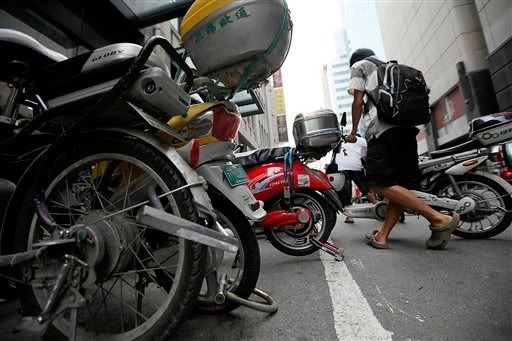

SHANGHAI — It's a simple pleasure, but Xu Beilu savors it daily: gliding past snarled traffic on her motorized bicycle, relaxed and sweat-free alongside the pedal-pushing masses. China, the world's bicycle kingdom — one for every three inhabitants — is going electric.

Workers weary of crammed public transport or pedaling long distances to jobs are upgrading to battery-powered bikes and scooters. Even some who can afford cars are ditching them for electric two-wheelers to avoid traffic jams and expensive gasoline.

The bicycle was a vivid symbol of China in more doctrinaire communist times, when virtually no one owned a car. Even now, nearly two decades after the country began its great leap into capitalism, it still has 430 million bicycles by government count, outnumbering electric bikes and scooters 7-1.

But production of electric two-wheelers has soared from fewer than 200,000 eight years ago to 22 million last year, mostly for the domestic market. The industry estimates about 65 million are on Chinese roads.

Car sales are also booming but there are still only 24 million for civilian use, because few of the 1.3 billion population can afford them. And unlike in many other developing countries, Chinese cities still have plenty of bicycle lanes, even if some have made way for cars and buses.

"E-bike" riders are on the move in the morning or late at night, in good weather or bad. When it's wet, they are a rainbow army in plastic capes. On fine days, women don gloves, long-sleeved white aprons and face-covering sun guards.

One of them is Xu, on her Yamaha e-bike, making the half-hour commute from her apartment to her job as a marketing manager. She had thought of buying a car but dropped the idea. "It's obvious that driving would be more comfortable, but it's expensive," she says.

"I like riding my e-bike during rush hour, and sometimes enjoy a laugh at the people stuck in taxis. It's so convenient and helpful in Shanghai, since the traffic is worse than ever."


Read On
A few months ago, I bought a mountain bike from a friend of mine who was returning back to America. The lightly-used bike, an XDS MA530, cost less than half of what I would've bought it for new. It's the best bike I've ever owned. It's a 21-speed, has shocks, and disc breaks. Here's a stock photo I just found of it on the internet:



While it is an old-fashioned pedal bike and not an electric one like those featured in this article, I can definitely relate with that last quote of the abstract above. Cruising around on a bike is vastly superior to riding other kinds of transportation.

As the article mentions, Chinese streets are well-equipped with bike lanes. Just about every main street in Xi'an has a small bike lane off to the side of the street for two-wheeled traffic. This makes cruising around (relatively) safe and quick.

I can get from my apartment into the city to meet Qian at work in about fifteen minutes on my bike. On a city bus, the trip would take at least twenty minutes (if I don't have to wait very long for the bus to come). And while a taxi would be faster than my bike, it'd cost about 15RMB ($2). So I view my bike riding as the best way for me to get around the city.

One of the interesting aspects of my bike riding in Xi'an is that I wear a cloth mask covering my mouth and nose as I cruise around. After I began riding several months ago, I realized that my throat would hurt after being out on the streets. Particularly after riding on a typical gray and smoggy day in Xi'an. I found wearing a mask really helps though. Sometimes I'll ride for a while, reach my destination, and then take off my mask only to find that the air outside actually stinks. But I hadn't realized this until taking off the mask.

It sounds as if the electric bikes are helping out with this problem of terrible urban pollution. Although the bikes are not a long-term pollution prevention because the bikes still require electricity (provided by, more often than not, coal-fired power plants in China) and have serious problems with disposal of the large batteries (that is discussed in the article above).

Despite the problems associated with electric bikes, they're a step in the right direction. I really enjoy seeing them on the streets of Xi'an. I have no problem being passed by an electric bike on the streets of Xi'an. A gasoline-powered one shooting exhaust in my face is another story all together.

And I can't expect all of China to stay content with pedal bikes like I am at the moment.

Sunday, July 26, 2009

Heading Back to Canton

Qian and I are going to Guangzhou tomorrow to, hopefully, take care of her visa once and for all. We've been approved, but still don't have the visa actually in her passport. We should feel relieved and confident the process is over, but there is a certain degree of nervousness given how the last trip there went and how the whole process has gone.

If something doesn't go according to plan tomorrow, I'll probably lose it and go nuts. That would be pretty funny to witness from outside of my body. Probably not much fun for Qian or me though.

But honestly, I don't think anything weird will happen.

We'll leave Wednesday night after the visa is ready and picked up.

It'd be great if the American consulate that handles all of this stuff wasn't in Guangzhou. The city isn't a place that Qian are dying to go back to. Beijing on the other hand...

Thursday, July 23, 2009

The Troubled CBA

I realize that I've been doing a fair amount of sports posts recently. I apologize to those completely uninterested. I'm just having a bit of trouble getting up the energy and motivation to wax about the latest goings on in the economic crisis or the political scene over here.

An article on the Chinese Basketball Association and its myriad of problems caught my eye yesterday. The league has quite the assortment of problems.

From The New York Times:


BEIJING — With 1.3 billion potential fans, China is increasingly seen as a financial promised land for N.B.A. stars through endorsement deals, and the league itself has established a robust organization here valued at $2 billion.

But China’s own professional league, the Chinese Basketball Association, has hardly enjoyed a smooth ascendance alongside this country’s basketball boom. American players and agents describe broken contracts, unpaid wages, suspicions of game-fixing and rising resentment toward foreign players. Several players have left China after failing to receive paychecks. Last month, the league announced that it lost $17 million last season, which ended in May.

Players and coaches in China’s professional league said problems escalated last season after the association loosened salary and court-time restrictions on foreign players, part of an effort to heighten the game’s appeal to China’s growing N.B.A fan base and to bring in more lucrative sponsorship deals. The association also hoped the prowess of imported players would help bolster China’s basketball prospects for the 2012 Summer Olympics.

The efforts yielded conflicting results. TV ratings soared, and foreign players found starring roles — the top 15 scorers were non-Chinese, and players like Bonzi Wells and Dontae’ Jones — who had less than stellar N.B.A. careers — frequently scored more than 40 points a game. At the same time, the dominance of foreign players fueled frustration.

“Foreigners should play supporting roles, not dominate the game,” said Zhang Xiong, director of operations for the Chinese Basketball Association.

...

The dominance of international players is not the only systemic problem in the 18-team league. Coaches, visiting players and their agents suspect that the outcome of some games is predetermined.

Players recounted locker-room lectures in which they were told to slack off on the court. On other occasions, they said, the best players had to sit out particularly competitive games or were sent home once their teams made the playoffs.

Gabe Muoneke, an American player who joined the Yunnan Bulls last season, said he was told by a Chinese teammate that a game against the Shanghai Sharks in November was fixed.

“He said, ‘Listen, my bookie told me we’re going to win today, so don’t worry,’” Muoneke said.

...

Muoneke said the incident confirmed what he and other players have long suspected: that game-fixing is a problem for the Chinese league.

“It’s common knowledge that Chinese teams bribe referees,” he said.

Read On
As much as the Chinese love basketball and as much as NBA Commissioner David Stern dreams of China being the future of the NBA, the country is having trouble embracing the game at the highest levels of competition.

Of course, I'd be remiss if I didn't mention about the problems that the NBA is having and has had over the past couple years. There have been plenty.

At the same time though, the NBA and its place either at or near the top of the global sports scene is well-established. And then China's attempt at a league appears to be flawed in a large number of ways.

My only explanation is that professional sports in China are a curious phemonenon.

Sure, the NBA and European soccer leagues are incredibly popular over here. But when you turn on CCTV 5, the nation-wide sports channel, pretty much all you see are Olympic sports. This is still the case now, in 2009, the year after the Olympics in Beijing.

From my subjective experiences, I've seen far more international ping-pong, badminton, and diving competitions than I have coverage of Chinese professional basketball or soccer leagues. The masses here just don't seem too keen on supporting their local teams.

I can't say exactly why the Chinese prefer international sporting competitions like China vs. Cuba in women's volleyball compared to domestic professional sports leagues like Dalian vs. Qingdao in soccer. But from the times that I've glanced at CCTV 5, it appears that Chinese people prefer watching its athletes competing against other counties than competing with each other in professional leagues.