Wednesday, October 7, 2009

Al Qaeda Not Only Against the West

China and America may not see eye to eye on everything. But that doesn't mean they can't share common enemies.

Form Reuters:

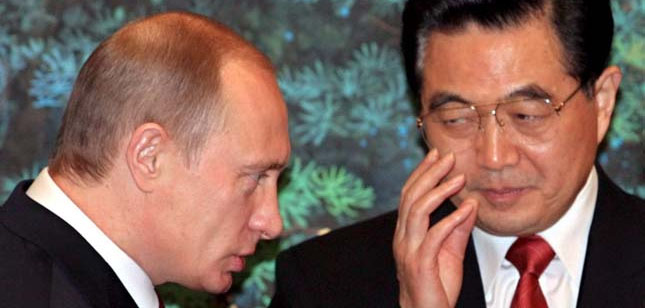
Image from Nationalpost.com

DUBAI, Oct 7 (Reuters) - A prominent al Qaeda militant urged Uighurs in Xianjiang to make serious preparations for a holy war against "oppressive" China and called on fellow Muslims to offer support.

Abu Yahya al-Libi, in a video posted on an Islamist website on Wednesday, warned China of a fate similar to that of former communist superpower, the Soviet Union, which disintegrated some two decades ago.

"The state of atheism is heading to its fall. It will face what befell the Russian bear (Soviet Union)," he said in the message in which he accused China of committing massacres against Uighurs and seeking to dissolve their identity.

Soviet forces invaded Afghanistan in 1979 to prop up a Marxist government against Islamist fighters, but was ground down by guerrilla warfare and withdrew in 1988-89. Al Qaeda emerged from the groups that fought Soviet forces at the time.

Read On
It sounds like China is on Al Qaeda's hate list because it is an atheist state (and hasn't converted to Islam). And the consequence of this is that China will fall like the former USSR?! Yawn...

I really shouldn't yawn. Al Qaeda could strike China or America or a whole host of other countries across the world and we'd be in a post-9/11 state all over again. I sincerely hope that doesn't happen. I feel like we (Americans) have only recently started to get over the unfathomable attacks perpetuated against us eight years ago.

There's no doubt that China's situation with its Muslim population in Xinjiang is a mess. The riots this past summer and the recent wave of "needle attacks" are proof that the China's having a bit of a "harmony" problem. But Al Qaeda is no answer to these problems. Hopefully none of the frustrated Muslims of China get involved in Al Qaeda's network of hate and terror.

Monday, October 5, 2009

A Nation of Spenders

Can the world economy count on China to open up its pockets as Americans are closing theirs?

From The Washington Post:

Image from mamondo.com

BEIJING -- Chen Zizheng wheeled his shopping cart down one of the aisles at the Carrefour store near his house and paused in front of the bottles of Remy Martin, Johnnie Walker and Hennessy, each selling for an amount about equal to the annual salary he earned when he was a young government employee.

But those days were about 30 years ago, around the time Deng Xiaoping launched China on a path of economic reform and opening up. Now China's thriving economy has made it possible for people like Chen, a 67-year-old semi-retired aerospace industry official, to plop down 1,168 yuan, or $170, for a bottle of liquor at a branch of a French "hypermarket" chain.

"It's not that expensive for ordinary Chinese people now," he said, adding that he planned to serve Johnnie Walker Green Label to guests he was expecting to share moon cakes with during last weekend's mid-autumn festival.

"As Chinese society has developed and opened up, people have a better appreciation of imported liquor," said Chen, who used to buy the traditional Chinese stiff drink known as maotai. "When you choose a gift, other people will look at it and if it is brand stuff they will feel respected because you chose it for them."

One year after the global economy went into a tailspin, many economists are wondering whether Chinese consumers, once a thrifty lot, will lead the world out of the recession. Last week, the International Monetary Fund said China would do just that, thanks in part to the government's $600 billion stimulus package and a flood of bank lending. The IMF increased its forecast of Chinese growth to 8.5 percent in 2009 while lowering its forecast for the U.S. economy, which it said would shrink 2.7 percent.

Read On
Chinese people, on the whole, are frugal. But their attitudes are changing. Especially when it comes to people living in cities who are getting rich.

Whether its Buicks or Louis Vuitton or Chivas Regal, Chinese people are quickly developing tastes for material goods. Any idea that China's history with communism took away the passion for these kinds of goods is dead wrong. China is a country full of new rich people. Just like in all countries in the world, people who have money for the first time in their lives like spending it.

I heard a lot of mockery about China's 60th anniversary on media reports this week in America. I suppose the mockery is deserved in a lot of ways. But westerners would be wise to look past this past week's homage to communism because it was just a big show.

China is becoming a blatantly materialist society and is more and more comfortable spending money. It'll take years. But I expect Chinese people to be making up for Americans' (much-needed) belt tightening before too long.

Sunday, October 4, 2009

Ryan Jiang's Podcasts

A good friend of mine from Xi'an, Ryan Jiang, has begun a radio show on China. You should check it out. Here is an episode on differing perspectives of contemporary China and here is an episode on 1989. There are more episodes on his main page.

I met Ryan during my first year in China. He is one of the smartest and most open-minded people I met in China. He is now studying and living abroad.

Saturday, October 3, 2009

US Losing Luster

When it comes to the question of which country the rest of the world would rather be with - the US or China - the choice is not as easy as it used to be.

From Korea's Chosun Ilbo:

Image from china-briefing.com

The American "hegemony" is receding, leading economist Jeffrey Sachs said Tuesday in an article for the Financial Times on the G20 Summit held in Pittsburgh. The article was titled "America has passed on the baton." In mid-September, 16 U.S. intelligence agencies released a document which pointed to Beijing as one of Washington's main global challengers in the future. All this shows that the U.S. is on the ebb in the 21st century, while China's international standing and influence are rising rapidly.

Since the Sept. 11, 2001 attacks, the U.S. has concentrated foreign policy attention on the Middle East, which it pointed to as the source of terrorism, but has paid less attention to Asia, Africa and Latin America. By contrast, China has been expanding its influence and raising its profile in those areas.

Citing Asia as an example, Newsweek said Asian nations are being asked to decide where they stand between the U.S. and China, as these two powers are building their respective alliances and engaging in fierce competition. All this was sparked by two military exercises staged in Asia in 2007. One was Malabar 07, an exercise initiated by the U.S. and joined by Australia, India, Japan, and Singapore. The other was the Peace Mission 07 under China's initiative and joined by members of the Shanghai Cooperation Organization such as Russia, Kazakhstan and Uzbekistan.

The SCO is a group formed by Beijing and Moscow in 2001 ostensibly dedicated to combating terrorism. With the exercise as momentum, weaker Southeast Asian nations such as Burma and Cambodia as well as Central Asian countries came under China's influence, experts say.


Read On
"Either you're with us or you're against us."

That doesn't have quite the same bite after Bush and his administration took their eye off the ball (China) and focused solely on "killing the terrorists" during their reign. Thanks for being such a visionary leader, President Bush.

The move away from China towards America isn't solely limited to alliances and political support. Businesses across the globe are lining up with China too.

From AFP:
ISTANBUL — The nascent global recovery is dividing Latin America between economies that pay the price for ties with the United States and those that benefit from growing links with Asia, experts said.

"The US economy is getting better, but with a lot of uncertainty along the road," Nicolas Eyzaguirre, the International Monetary Fund's Latin American director, said at a conference Friday in Istanbul.

"The effect on Latin America will be very different depending on what's your level of policy preparedness and what's your linkage with the US and vis-a-vis Asia," he said.

In its economic forecasts published Thursday, the IMF said that Latin America had begun to recover from the global economic crisis and would post growth of 2.9 percent in 2010.

But there were wide disparities, with countries such as Mexico, which depends heavily on the United States, losing out and others like Brazil benefiting from rising exports to China.

The United States is the epicentre of the crisis, while China is leading global growth.

...

Goldfajn, a former deputy governor Brazil's central bank, said Brazil used to export mostly to the United States, but "China is overcoming exactly now the US as our main export destination" for the first time in the country's history.

The economist said that generally the region's economic health depends on the degree of economic links to the United States, saying Colombia, Brazil or Argentina were at a safer distance.

Read On
The awarding of the 2016 Summer Olympics to Rio was a substantial repudiation against the US. The rest of the world is not in awe of the US' greatness any more. It's gotten so bad that Obama's visit and impassioned plea to the IOC was rewarded with being the first site to be eliminated. I understand that there were a lot of politics not related to Obama behind the decision, but there's no doubt that Chicago being eliminated first was a substantial, symbolic slap in the face.

America is way off of where it was even a decade ago. It's hard to see how or when it will get back to where it once was.

China is on the rise and is going to continue to be a yin to America's yang.

Thursday, October 1, 2009

Rich and Poor

China's economy continues to rise. But not everyone is ascending.

From Forbes:

Image from nataliebehring.com

Oct. 1 (Bloomberg) -- At China’s newest Gucci store, in Shijiazhuang, snakeskin purses sell for the equivalent of $4,390, about twice the city’s per capita annual income. Next door at Brooks Brothers, button-down shirts go for $190.

“Shijiazhuang is becoming very well off,” Brooks Brothers saleswoman Wang Weixia, 24, says of the provincial capital, 291 kilometers (181 miles) southwest of Beijing. “A few years ago it was poor and backwards.”

Five floors up in the food court of the First Under Heaven mall, a lamb kebab griller surnamed Li has a different view. “The people here got rich by cheating others,” says Li, who earns 50 yuan ($7.30) a day and declined to give his full name.

The scene in Shijiazhuang is replayed across China, where a 30-year economic boom has lifted hundreds of millions of people from poverty at the price of yawning income gaps. China’s Communists came to power 60 years ago today, promising a utopian society run for the benefit of peasants and workers. Instead, it was ideological foes in neighboring Taiwan and South Korea that delivered economic gains more widely and equitably.

The growing wealth gap is a top concern for President Hu Jintao and Premier Wen Jiabao, who are dealing with rising protests from workers and farmers angry at corruption and the perception that some people are getting rich at the expense of many. Hu and Wen today took part in celebrations in Beijing marking the anniversary.

In a Sept. 10 speech to the World Economic Forum in the city of Dalian, Wen said China must “narrow the gap in income distribution.”

Read On
A rich man discarding trash onto the street. A relocated farmers picking up the refuse. Migrants huddled on street corners holding up signs saying 水电 (water electricity) looking for work. Little old ladies lugging massive carts of trash or recycled goods in bicycle lanes.

Although I've left China, these kinds of images are still burned onto my brain.

Having lived in a booming interior city of China, I've seen the income gap this article talks about first-hand. You see these scene play out walking down nearly every street in Xi'an.

China's growth is a great thing. It is making life better for millions upon millions of people. I hope that China's new-found wealth can trickle down to those not at the top rungs though. It can and has, but as the article goes on to say:
204 million people in China lived on $1.25 a day or less as of 2005, a 2008 World Bank study showed.

Expenses for health care and education, once provided at no cost for many workers, are pushing more people into poverty, said Dorothy Solinger, a professor at the University of California at Irvine who studies China’s urban poor.

“There isn’t a sense of upward mobility,” Solinger says. “There is a perpetuation of underclass.”

I'm not sure what the best way to curb income inequality is. More progressive taxes? I don't know. Whatever the solution may be, I hope that China's ever-widening gap can get under control. There are just too many people in China, and America for that matter, that are just barely getting by.