Wednesday, September 16, 2009

Internet Access, Climate Calamity, and Politicking

It's been a while since I've had the time to sit down, type "China" into Google News, and read about what's going on in the country. Maybe it's because I haven't been online in a while, but I was really intrigued by a number of articles today.

First, an article from the Los Angeles Times on the newest of China's netizens - low-paid workers:

Image from nataliebehring.com

Reporting from Shenzhen, China - When Jiang Dabao lost a hand to a molding machine three years ago, his boss said he wasn't eligible for workers' compensation. Unemployable, Jiang whiled away his days in the Internet bars that thrive in China's manufacturing heartland.

Eventually he tapped into QQ, a popular social networking service, where he found a worker advocacy group that helped him win a $30,000 settlement, said Jiang, who identified himself by his childhood nickname for fear of official reprisal.

Forums have become the Chinese proletariat's equivalent of Facebook or Twitter and are seen by some as the beginnings of a labor movement.

Authorities and factory owners are eyeing the networks warily. Sites dedicated to grievances have been shut down, and stories about worker rallies are regularly deleted, according to labor advocates. The QQ forums are capped at 100 users, making mass mobilization more difficult.

Still, the potential remains for groups to organize through social networking.

Authorities alleged that exiled separatists used the Internet to urge ethnic Uighurs to riot in China's western Xinjiang province in July; the government cut Web access in the region for days.

"Nobody can predict when the Chinese working class will have uproar. It may be once in a lifetime, but if it happens, it will change everything," said Jack Qiu, a professor at the Chinese University of Hong Kong who follows the Internet in China.

Until a few years ago, factory workers missed out on the Internet boom. But that changed with the explosion of Internet cafes and cheap cellphones that enabled users to go online.

Read On
It's great that new technology is giving the bottom rung of China's society the opportunity to get online. China is going to continue to clamp down on its country's internet as much as possible. But I like to think that the more people that get online and get used to having a voice the better. It'll be harder for the powers that be in China to restrict people the longer people are used to having the ability to enjoy some degree of freedom online.

Second, an article from AP on the future of climate change:

Image from The Guardian

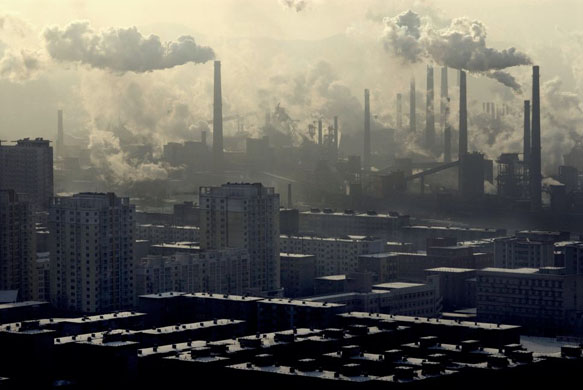
BEIJING — If China's economy continues to expand rapidly and rely heavily on coal and other fossil fuels until the middle of the century, its power demands could exceed what the entire planet can withstand, according to a study by government think tanks released Wednesday.

The two-year study, supported by the U.S.-based Energy Foundation and the international environmental group WWF, also said if China's energy usage structure remains unchanged, its emissions of greenhouse gases blamed for global warming would reach 17 billion tons a year by 2050. That would represent 60 percent of total global emissions and three times China's current production, it said.

"If the current mode of economic development drags on, the scale of China's fossil fuel consumption will be shocking," said the study, titled "China's Low Carbon Development Pathways by 2050."

The researchers said global warming will challenge China more than many other countries, with its developed east coast cities contending with rising sea levels, and already drought-prone agricultural areas suffering further water shortages.

Read On

I've talked before about the contradiction/irony/tragedy of climate change. The West has been developing and industrializing for two hundred years, yet now it is China's recent growth that may very well push the world past the brink. The West been enjoying the fruits of industrialization for generations, yet now that China is getting there, there's a climate crisis and they can't use (is pillage more appropriate?) the Earth in the same way already industrialized nations have.

I'm not saying that China shouldn't change or that the West is evil or anything. I just think the whole situation is pretty interesting when broken down.

Third, an article from Asia Sentinel on the things being discussed at China's annual CCP Plenum:


While most plenary sessions of the Chinese Communist Party's Central Committee – usually held once a year – merely endorse decisions made by the supreme Politburo Standing Committee, the plenum now taking place in Beijing deserves special attention.

Party insiders say Vice-President Xi Jinping, 56, may be promoted to the vice-chairmanship of the CCP's Central Military Commission. This will not only confirm Xi's status as Hu's successor as party general secretary and state president, but also spell a bonanza to the political fortune of the "Gang of Princelings" – the offspring of party elders – that Xi heads.

Xi, the son of former vice-premier Xi Zhongxun, does not come from the Communist Youth League faction led by President Hu Jintao. And Hu, who has been military commission chairman since 2004, has maneuvered to delay Xi's induction to the policy-setting military organ. One reason is that while the princelings are heavily represented in the top echelons of the People's Liberation Army, very few youth league affiliates have attained senior ranks in the defense forces.

Within the standing committee put together at the 17th Party Congress in late 2007, Xi outranks long-time Hu protégé Li Keqiang, who as First Vice-Premier is expected to take over from Wen Jiabao as premier in 2013. It is understood, however, that Hu has hoped to delay Xi's induction to the military commission so as to allow Li, a former party boss of the Youth League, time to build up a power base at the top.

However, recent events in Xinjiang, in which more than 200 people were killed in ethnic violence since early July, have dealt a blow to the Youth League faction. The bulk of the top cadres running Xinjiang and Tibet, including their party secretaries, respectively Wang Lequan and Zhang Qingli, are veteran youth League affiliates.

Read On
I have a hard time getting excited about Chinese politics. But succession debates and possible grabs for power at the top are always gripping theater.

Given how chaotic things have been for China recently (really for a couple years now), I'm not surprised that a serious look at what's going on with China's power structure is happening. I wouldn't think that the upheaval and general "disharmony" that's taken place over the past couple years in the Middle Kingdom is sustainable.

Well, this coffee-induced news round-up has been fun!

Tuesday, September 15, 2009

Living in the Shadows

At the end of 2008 and in the first few months of 2009, I wrote a lot about the plight of Chinese migrants. There were a lot of media reports about the millions upon millions of migrant workers who were either struggling to find work in Chinese metropolises or who had simply returned to the countryside dejected.

I haven't seen too many reports about migrants in recent months. I have to assume that most of the millions struggling at the beginning of 2009 eventually found work. The last figure I saw said that there were (only...) four million still looking for work. So it appears as if the crisis of unemployed migrants from last winter is not too severe right now.

I got an email from someone at The Global Post the other day. They directed me to some recent reporting that they've done on Chinese migrant workers entitled: Living in the Shadows. I suggest you click that link and go check out what they've put up over there. The videos, in particular, give the viewer a fascinating glimpse into the daily struggle of those on the edge of China's growth.

Monday, September 14, 2009

Tires and Chickens

Is protectionism about to kick into higher gear?

BEIJING -- China indicated it would restrict U.S. imports of chicken and auto products and demanded trade talks after Washington's move to slap punitive sanctions on Chinese tire imports, raising tensions in ahead of two planned meetings between the countries' leaders.

Many observers in China say ties between the nations should remain unharmed, noting that China's measures could limit imports in two areas that it already tightly controls -- and thus might not have a huge effect on U.S. exports. But the measures add to worries about trade protectionism amid rising unemployment around the world.

Citing a jump in Chinese imports, the Obama administration said Friday it would impose stiff tariffs on Chinese-made tires for the next three years, invoking a section of trade law that China agreed to as a condition for its joining the World Trade Organization in 2001. The move essentially would cut off the source of nearly 17% of all tires sold in the U.S. last year and hit cost-conscious consumers particularly hard, as retailers will have to find alternative sources for the lower-end tires that make up much of what China sends to the U.S.

Beijing responded quickly. Sunday, its Ministry of Commerce said it was starting antidumping procedures against U.S. exporters into China of chicken and auto products. It said it had received complaints from local producers that the U.S. products were being dumped in China at below-market prices. The ministry denied that the move, which could lead to sanctions, was protectionist.

"China has consistently opposed trade protectionism, and the country's actions since the financial crisis have reflected this stance," the ministry said on its Web site. "China is willing to continue to act in accordance with countries around the world to push forward the world's economic recovery."

Read On
The end of the article quotes some observers and analysts who say that this spat isn't that big of a deal and is, in fact, inevitable given the state of the world economy. I can see where this point of view is coming from. It's understandable that US politicians are feeling pressure from unions and other groups dissatisfied with what is going on these days and feel like they have to act.

It'll be interesting to see whether this is a one off event (or just a series of small disagreements) or the beginning of a larger trade war.

I don't think it'd be wise for the US to try to ramp things up here. Sure, the economy sucks and there are a lot of people who'd love to see Chinese products blocked from entering the country. But I think that closing down free trade right now is going to make things much worse than they already are.

Personally, I'd rather not live through a reincarnation of Smoot-Hawley.

Sunday, September 13, 2009

Chinese Bunnies

Hugh Hefner is proud of his company's growing presence in China.

From The Press Association:

Image from Shanghaiscrap.com

Hugh Hefner hopes his Playboy brand can help encourage democracy in China.

The 83-year-old said the bow-tied Rabbit head was a popular emblem in the communist country, adding that it represented freedom.

He added that this was the case despite the magazine not being permitted on the mainland.

Speaking during a Q&A session at the Toronto Film Festival, Hef waxed lyrical about the power of the Playboy brand.

He told the audience that in China "the rabbit is increasingly representing - for men and woman - personal, economic and political freedom. That is what I want."

Read On

Playboy brand clothes are all over China. I'd always thought that the clothes were shanzhai and didn't have anything to do with the actual brand. But apparently Hef is down with Playboy's presence in China, so that must mean he's getting a cut of at least some of the products over there.

I just asked Qian whether Chinese people even know that Playboy is a pornographic magazine. She thought that many don't know. It's not as if the Chinese could actually access any Playboy material on the country's locked down internet. So I'm not surprised that many wearing the bunnies on their shirts don't even know what they represent in the West.

While Hef sees his company as a beacon of liberalism in communist China, he probably shouldn't get ahead of himself in what his bunnies actually represent in the country. It's probably more of a trendy label rather than an endorsement of his open lifestyle.

Saturday, September 12, 2009

NFL Reality TV

This is a weird one.

From The Washington Post:

Image from letsgomobile.com

On a pockmarked Loudoun County field of mud and weeds, the National Football League came to sell itself to China, a country it once never believed to be interested in football. It did this in an experiment the buttoned-down league has never dared to try before, with one of Asia's most beloved rock bands running around a children's flag football game last week, trailed by a film crew, making of all things -- a reality TV show.

"We've started to understand what the code is to get into the Chinese market," said Chris Parsons, the NFL's vice president in charge of international operations. This has almost nothing to do with the game of football itself, something the NFL has had little success pushing anywhere internationally, but with something far different: American culture.

Which is how Stone, Monster, Ashin, Masa, and Ming -- the members of a Taiwanese band called Mayday -- happened to spend 10 days riding a bus around the Northeast this month, meeting cheerleaders and marching bands and playing flag football for a TV show that will run on China Central Television, or CCTV, this fall. All in the hopes of converting tens of millions of Chinese into fans of American football.

It speaks to just how desperate the NFL is to make this happen.

...

There is little interest in football in China, where the most popular sports are table tennis and badminton. And while many young Chinese are big fans of the NBA and English Premier League soccer, both of which are broadcast on local television, the glimpses they have gotten of American football are bewildering.

"It's like explaining cricket to us," said Chad Lewis, the former Philadelphia Eagles tight end who as a student at Brigham Young University spent two years doing his Mormon mission in Taiwan and has become familiar with China in recent years.

Read the whole article
I wrote a LONG post about the NFL in China several months ago (this post is actually one of the best I've ever written, in my opinion at least). So I'm not going to get into the details of the inherent reasons why (American) football getting big abroad will be difficult right now since I've already done so.

The use of the band super pop group Mayday to promote the NFL is bizarre. I suppose the NFL has to get creative in trying to get its product into China. But having a group of Taiwanese teeny-boppers running around NFL headquarters and schmoozing with cheerleaders with the hopes of getting the Chinese masses into the game is going to be... interesting.